“Changing the hope indicator”: High school students in rural Washington gain college confidence
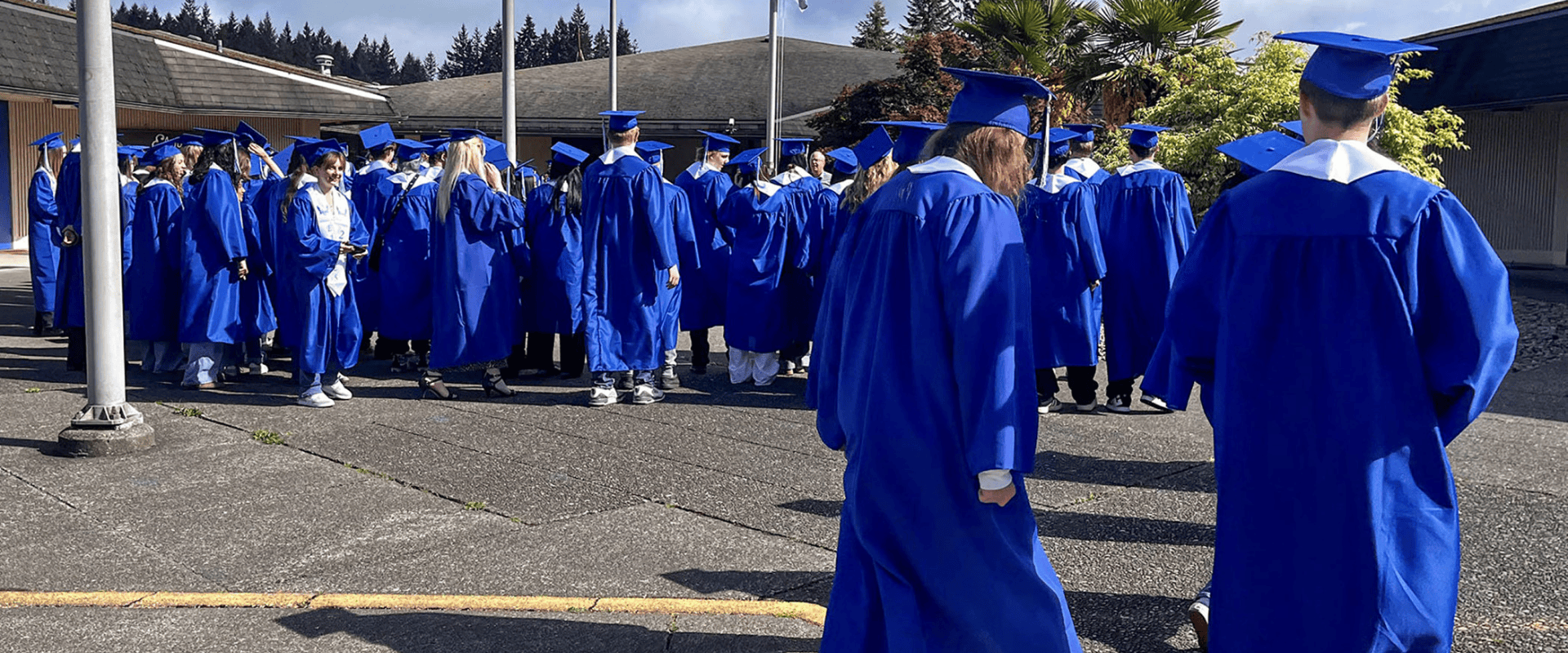
After partnering with Accelerate ASU, Elma School District triples its college-going rate for students
In the rural town of Elma, Washington, educators are building a culture of possibility for the next generation.
When superintendent Christopher Nesmith was hired in 2021, only 8% of high school seniors in Elma School District entered postsecondary schools or training programs.
Residents of Elma have spent decades navigating economic shifts following the cancellation of a major nuclear energy project in the 1980s. Those changes left lasting impacts on the community, shaping how many students viewed their futures.
Determined to help students realize their potential, Nesmith began rethinking how college access could work in a rural community.
“When you start creating scaffolds for a hopeful future, almost everything else starts to come into place, too,” Nesmith said.
He found a solution through Accelerate ASU, a nationwide, university-based dual enrollment program that gives high school students access to affordable, flexible college courses.
Unlike other dual enrollment options available to Nesmith, Accelerate ASU requires no additional staff to be hired. Students gain access to Universal Learner Courses taught by ASU faculty in a variety of subjects including STEM, the humanities and more. ASU’s model is low-risk, as students only add a course to their transcript if they’re satisfied with their final grade.
“Accelerate ASU is the solution that I think every rural school district in America needs to be looking at,” said Nesmith.
Gateway to a college-going school culture
By providing access to college-level courses, Superintendent Nesmith believed that he could begin to shift students’ attitudes — helping them see themselves as college material and reimagine what their futures could hold.
While Washington offers a fully funded dual-enrollment program to in-state schools, Nesmith says it was an impractical starting place for a small, rural district like Elma. The program requires a full class of interested students and hiring a new teacher for each course. For rural districts with limited funding and smaller student cohorts, this posed a challenge.
Accelerate ASU, by contrast, offers a flexible, cost-efficient alternative that better met Elma’s needs early on.
Nesmith ultimately took a hybrid approach, using Accelerate ASU as an entry point to build momentum and begin fostering a college-going culture across the district.
“If I have five kids in an English 101 class with Central Washington University, the cost of that teacher dramatically eclipses the cost of Accelerate ASU,” explained Nesmith. “So we run Accelerate ASU until we have enough students for a cohort of a class, and then we’ll move them into what Washington state calls the ‘High School Program.’ We’re constantly growing and jockeying and growing and jockeying.”
As more students succeed in college courses, others are inspired to follow their lead.
“How do you make a cultural change? Well, I need to start with five kids, and I need to show five kids they can do it,” said Nesmith. “Then I show 10 kids that they can do it. Then 20 kids. Accelerate ASU is the gateway to our culture change.”
Tripling the college-going rate
After partnering with Accelerate ASU for three years, Elma School District saw a dramatic improvement in its college-going rate, increasing from 8% in 2021 to 24% in 2024 — the highest rate in the history of the district.
Nesmith says the positive impact of the program goes beyond just numbers.
“There’s not really a data indicator on hope, but it’s changed the hope indicator for students,” he says. “Now everything’s going better — in our athletics, we’re winning more games, more kids are turning out for activities and so much more.”
One of the biggest perks of ASU’s program, Nesmith adds, is the flexibility. One teacher can facilitate a class of 20 students who are each taking a different Universal Learner Course, allowing students to explore their unique interests without the need to hire additional staff.
Nesmith gives the example of Dennis, currently a junior, who will graduate high school next year with a bachelor’s degree through a combination of courses offered by Accelerate ASU and Washington state’s dual enrollment programs.
“We use a variety of dual credit programs that we probably would have never been able to do had we not used ASU to change the culture,” says Nesmith. “Through Accelerate ASU, I was able to change that trajectory of our campus and our district.”
A model for other rural districts
Looking forward, Nesmith hopes more rural districts will take note of Accelerate ASU.
“Small rural districts are generally not thought of when it comes to state implementation. When I speak about this with other rural districts, they’re all in the same boat,” says Nesmith. “One of the best pieces of feedback I’m getting is from other superintendents who’ve been put under pressure by their families to use Accelerate ASU, because those families have heard from our families what we’re doing. Meeting the needs of small rural communities is a story that I feel like more small rural districts need to hear.”
Elma School District is one of Accelerate ASU’s 550+ past and current partners from around the world.
To Audrey Moreno, senior director of Accelerate ASU, stories like Elma’s exemplify Accelerate ASU’s mission.
“Rural students often face barriers that aren’t always part of the traditional conversation around college access,” says Moreno. “In some rural communities, students may be balancing family responsibilities, contributing financially at home or navigating college decisions without the same exposure to higher education pathways and resources. For many students, leaving their community to pursue college may not feel financially, logistically or culturally realistic. That’s why creating access within the community itself matters so deeply.
Accelerate ASU allows students to pursue college aspirations without having to leave their hometowns, and it does so in close partnership with their high school, where trusted educators and support systems already exist. By embedding college opportunities directly into the high school experience, we’re helping students build college-going confidence, expand their sense of possibility and explore futures that may extend beyond the boundaries of their immediate environment, while still honoring where they come from.”
To learn more about dual-enrollment opportunities for your students or child, visit accelerate.asu.edu.