Q&A: How to take the stress out of transferring college credits

Jaime Smith’s The Complete Guide to College Transfer demystifies common transfer experiences that students face
Applying to college as a first year student can be challenging. When it comes to transferring colleges — whether partway through a four year degree, as an older adult returning to college after a break or as a community college student hoping to attend a university — the path can become even murkier.
While transfer enrollment dipped during the pandemic, it has since rebounded, with a 7.9% increase in transfer students between 2020 and the fall of 2024. Prepandemic numbers suggested that nearly a third of college students transfer at least once within six years.
Smith has partnered with Accelerate ASU to bring dual enrollment to students at Online G3, which primarily serves homeschool families.

Jaime Smith, a Certified Educational Planner and founder of the virtual K-12 school Online G3, provides a guiding light through the transfer experience through her new book, The Complete Guide to College Transfer.
She says that a wide range of students need to utilize transfer credits during their academic journeys, including homeschooled students who earn college credits while still in high school and students enrolled in ASU’s Universal Learner Courses (ULCs), which offer a flexible and affordable route to college credit in disciplines including STEM, the humanities, and more.
G3 continues to have about an 87% credit-eligibility rate, with 130 students having taken ULCs. since they began the program in the summer 2021 session. Students have become credit-eligible in 285 classes, with 80 additional classes currently in progress.
Of course, after earning college credits, students face the next step in their journey — applying these credits towards a degree, certificate or professional pathway.
We sat down with Smith to discuss how to navigate the transfer process and leverage credits to help students meet their unique academic and career goals.
Note: Answers have been edited for length and/or clarity.
Question: Can you tell us what inspired you to write this book?
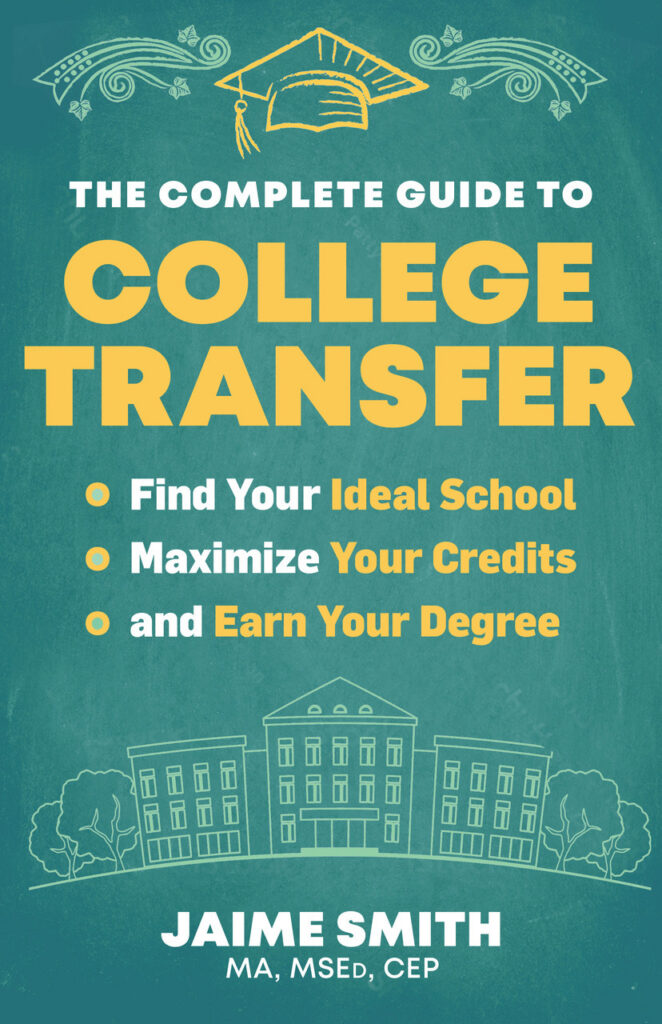
Answer: I’ve been in education for almost 30 years now, and I’ve taught at all levels. Over the years, as I got more into college questions — kids applying to college, kids doing dual enrollment — it became clear that the transfer of credit is challenging, and figuring out how to even apply for transfer to colleges is very complicated and varies widely.
There’s some consistency in applying as a first year. Everybody decides on May 1st, for example. But with transfers, the whole situation is so complicated, and there’s not a lot of knowledge around it.
Q: Who is this book for?
A: This is a book for anyone hoping to learn about how to transfer colleges, whether you are starting at a community college and intentionally trying to enroll as a transfer student, or you’re an older adult trying to come back to college after a break, or maybe you’re at a four year university and it’s not working, so you want to apply for transfer to another four year university. It could also be some combination of those things. The book also discusses transfer of credit, which dual enrollment students have found applicable as well.
I’ve written it to students, but the information in there is really valuable for parents, counselors, people working in universities — anybody who’s trying to support transfer students.
Q: Transfer students have a unique set of needs. What are the common challenges they face?
A: A lot of it is about knowing how your credits will transfer — will they fulfill requirements at the next university that make you eligible for transfer? Are they fulfilling requirements for your degree, or will you get in, transfer and then basically be starting over?
There are some universities that make that very easy to figure out — ASU is one of them. There are other universities where it’s like a black box, and you don’t know until you’re enrolled how your credits are going to transfer. Every college makes their own rules, and some are more flexible than others. You have to know what questions to ask in advance so you’re not restarting your degree at the next institution.
Q: You’ve worked with many transfer students who have taken ASU’s Universal Learner Courses. How do these courses fit into the transfer experience?
A: I recommend Universal Learner Courses (ULCs) often for students who are trying to get credits that they know will transfer in a certain way. Because ULCs are so accessible, it’s very easy for any student to jump in and take the course.
Actually, yesterday I recommended ULC English 101 and 102 to a student who was trying to transfer from one four year college to another four year. The place where he is now has this funky, interdisciplinary kind of writing class, and other universities are not seeing that as a freshman composition class.
To even be eligible to apply for transfer, he needed something that looked like a freshman writing class. So I said, ‘Well, I have a solution. You know what you have time for while you’re still at this four year university, working on your degree? You have time for an online class. You have time to take English 101 and 102 online while you’re also working on these other classes. And then you will actually be eligible for transfer.’
ASU is very forthcoming with all of their transferability. A lot of students have used ASU. Any university that shares a list of transferable credits or credits they previously accepted in the past, they almost always have English 101 and 102 from ASU on there. And so it’s a known entity.
Q: Anyone can be a transfer student, but you’ve specifically worked a lot with students who may be homeschooled or may have unique needs. How have ULCs served the homeschool population?
A: Homeschoolers are a really unique group, because they don’t always have access to the things that school students take for granted, such as AP classes. It’s difficult for them to show that they’ve taken a rigorous curriculum. So the best way, in my opinion, for homeschooled students to show that they are ready for the rigors of college is to already have succeeded in college classes and ULCs make that very accessible – financially and in terms of not having GPA requirements or age limits. So for homeschoolers, it’s really a fantastic option.
Q: Is there something that you wish institutions would keep in mind for the future?
A: I wish for more transparency from institutions. I wish more schools were clear about their policies and would share databases of courses that have transferred in the past. ASU has MyPath2ASU, which is amazing. You put in all your classes and see exactly how they apply to a degree. I wish more universities were that forthcoming with information so that students could see in advance how things might transfer, and also plan ahead.
Q: Do you have any other student stories you’d like to share?
A: I had a student who had had a bad experience at a four year university, dropped out, didn’t do college for a while, and then wanted to kind of dip a toe back in. She came out of that first school thinking, ‘Maybe I’m just not college material.’ So the idea of going back to college was really intimidating.
I recommended ASU’s ULCs, because there’s no penalty on your transcript if it goes badly and it’s cheap to start. That gave her the confidence to go forward, and now she’s taken many ULCs and is planning to enroll in ASU Online to finish her bachelor’s degree. And I think that really shows the power of flexibility, transparency and making things accessible. It can make a huge difference for someone who is trying to finish a degree where they might have otherwise given up.